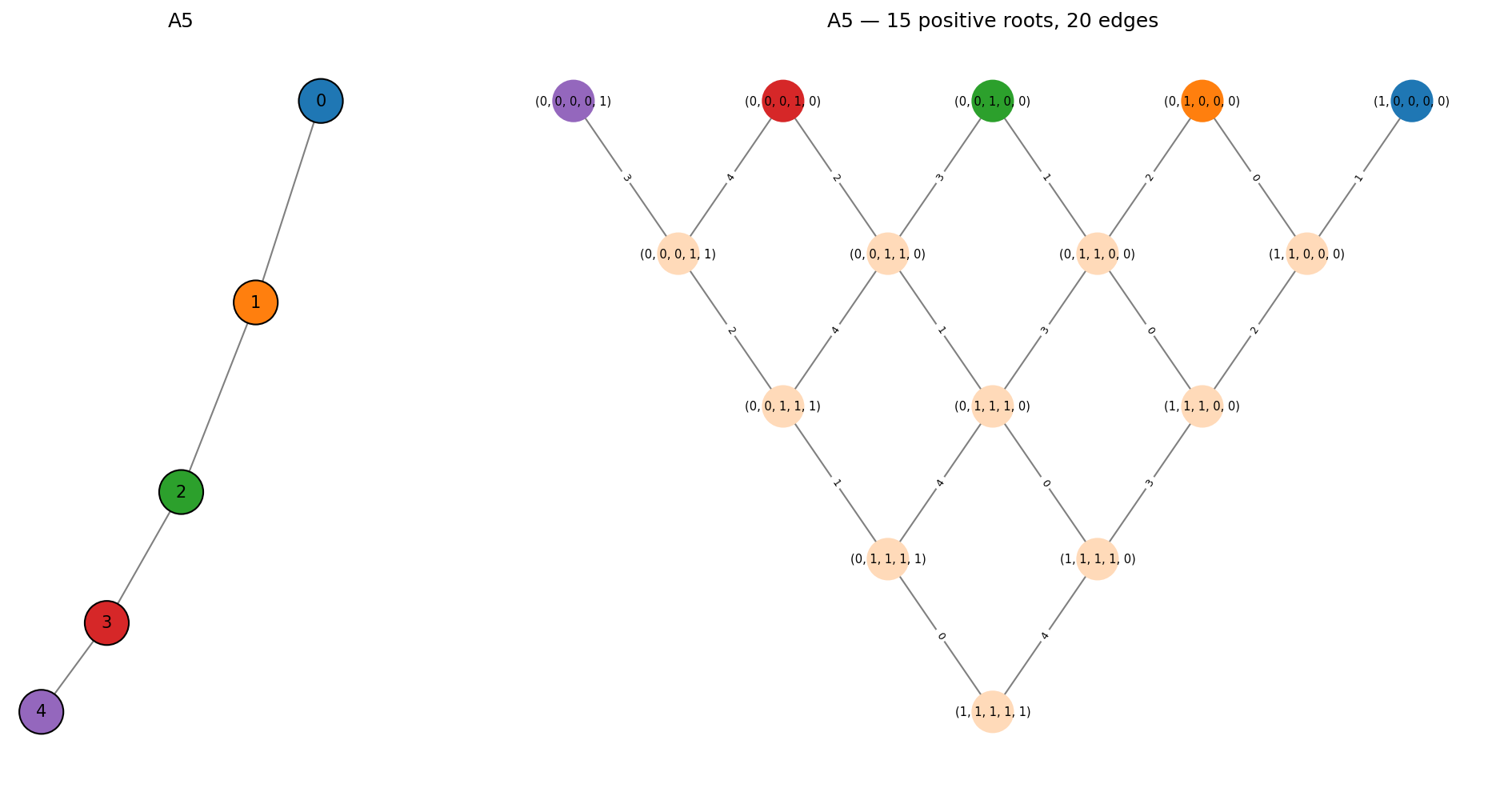
Type A – Path Graphs
The \(A_n\) Dynkin diagram is a path graph on n nodes:
The root system has \(\frac{n(n+1)}{2}\) positive roots and \(n(n+1)\) roots in total. These correspond to the root system of the special linear Lie algebra \(\mathfrak{sl}_{n+1}\).
The positive roots are exactly the vectors \(e_i + e_{i+1} + \cdots + e_j\) for all \(0 \leq i \leq j \leq n{-}1\), i.e. contiguous segments of 1s.
A1
The simplest case: a single node with no edges.
>>> from mutation_game import MutationGame
>>> game = MutationGame.from_dynkin("A1")
>>> print(game.adj)
[[0]]
>>> roots = game.calculate_roots()
>>> for r in roots:
...     print(list(map(int, r)))
[-1]
[1]
There is 1 positive root (the simple root itself) and its negative. The Weyl group is \(\mathbb{Z}/2\mathbb{Z}\) – a single reflection.
A2
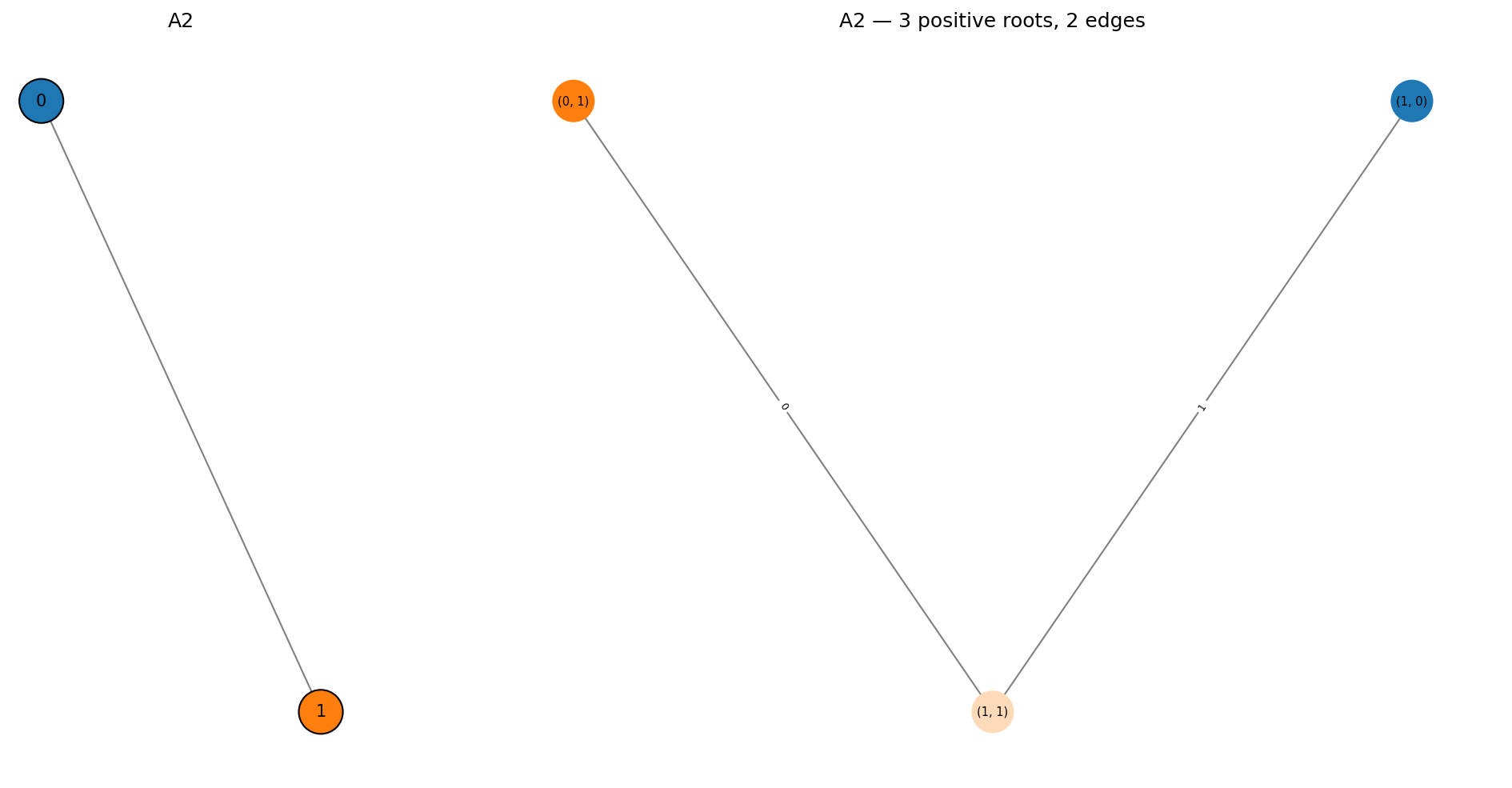
Two nodes connected by a single edge. The root system of \(\mathfrak{sl}_3\).
>>> game = MutationGame.from_dynkin("A2")
>>> for r in game.calculate_roots():
...     print(list(map(int, r)))
[-1, -1]
[-1, 0]
[0, -1]
[0, 1]
[1, 0]
[1, 1]
3 positive roots, 6 total. The highest root is \((1, 1)\).
A3
The root system of \(\mathfrak{sl}_4\), with 6 positive roots and 12 total.
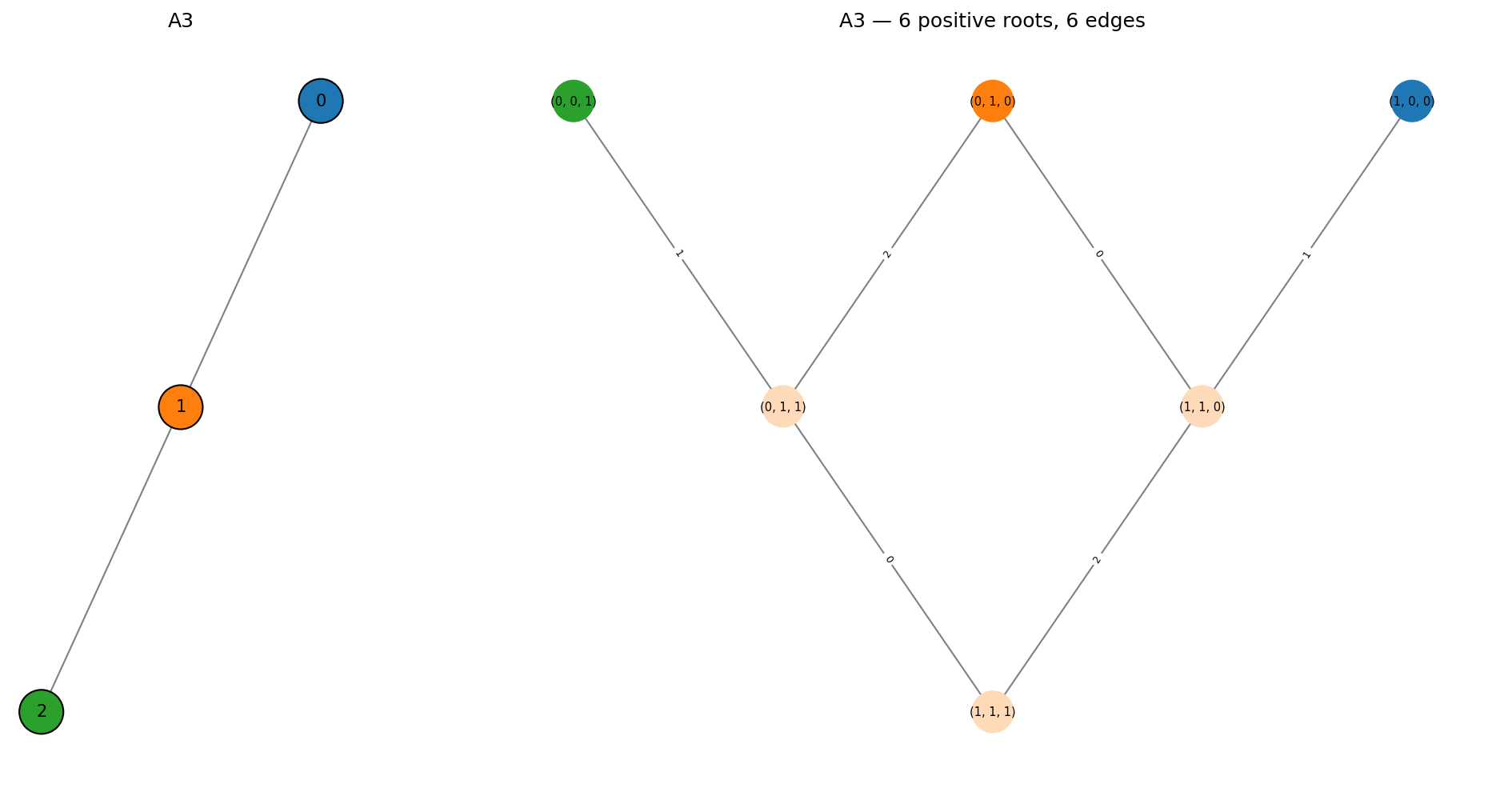
The mutation path table for A3:
>>> game = MutationGame.from_dynkin("A3")
>>> game.print_mutation_path_table()
Source     Target     Mutations         Len
-------------------------------------------
(0, 0, 1)  (0, 1, 0)  1 -> 2            2
(0, 0, 1)  (0, 1, 1)  1                 1
(0, 0, 1)  (1, 0, 0)  1 -> 2 -> 0 -> 1  4
(0, 0, 1)  (1, 1, 0)  1 -> 2 -> 0       3
(0, 0, 1)  (1, 1, 1)  1 -> 0            2
(0, 1, 0)  (0, 1, 1)  2                 1
(0, 1, 0)  (1, 0, 0)  0 -> 1            2
(0, 1, 0)  (1, 1, 0)  0                 1
(0, 1, 0)  (1, 1, 1)  0 -> 2            2
(0, 1, 1)  (1, 0, 0)  2 -> 0 -> 1       3
(0, 1, 1)  (1, 1, 0)  2 -> 0            2
(0, 1, 1)  (1, 1, 1)  0                 1
(1, 0, 0)  (1, 1, 0)  1                 1
(1, 0, 0)  (1, 1, 1)  1 -> 2            2
(1, 1, 0)  (1, 1, 1)  2                 1
The Cartan matrix and its spectrum:
>>> print(game.cartan_matrix())
[[ 2 -1  0]
 [-1  2 -1]
 [ 0 -1  2]]
>>> print(game.cartan_eigenvalues())
[0.58578644 2.         3.41421356]
A4
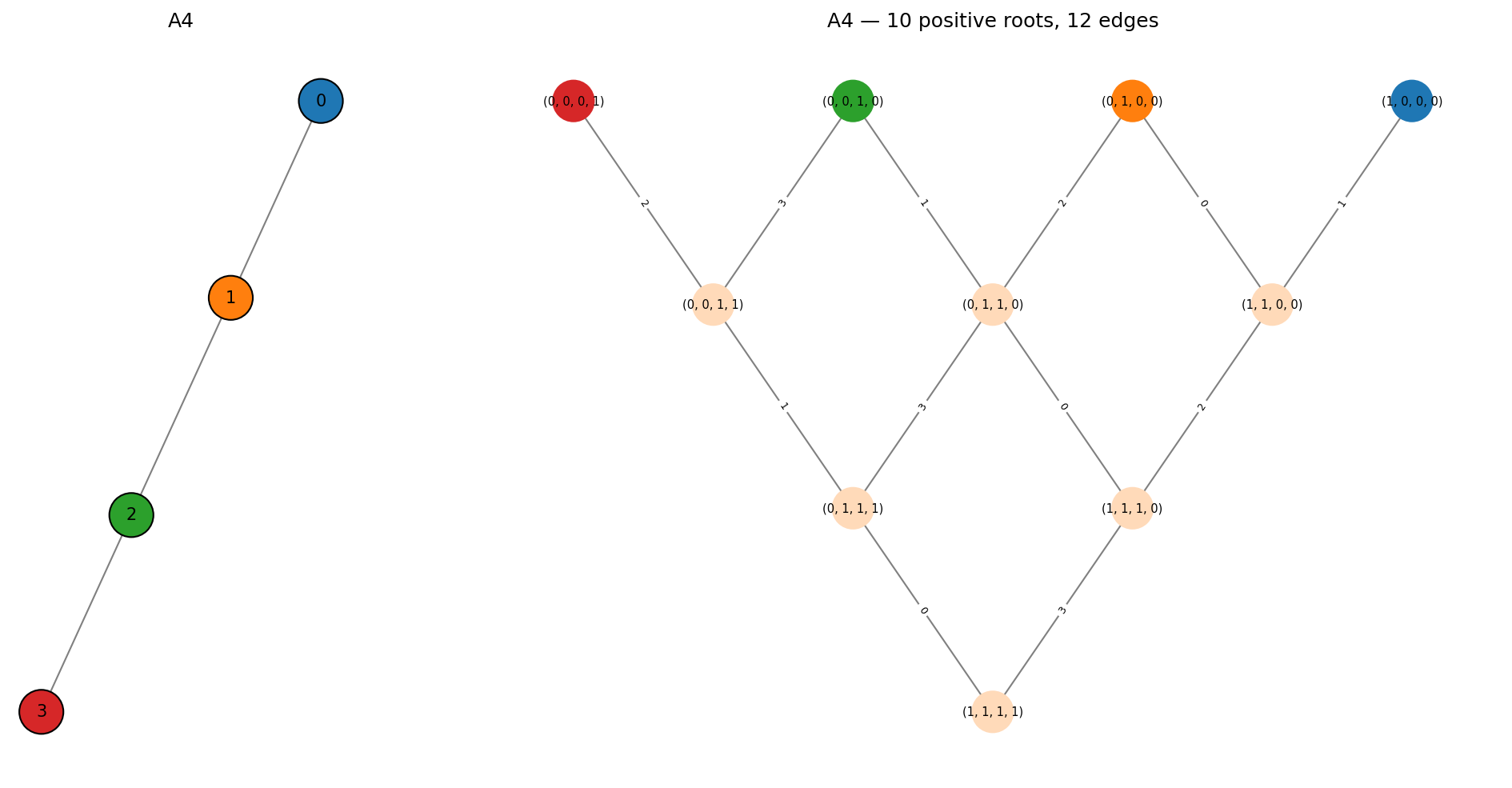
The root system of \(\mathfrak{sl}_5\), with 10 positive roots and 20 total.
A5
The root system of \(\mathfrak{sl}_6\), with 15 positive roots and 30 total. This is the largest A-type where the mutation graph remains visually manageable.