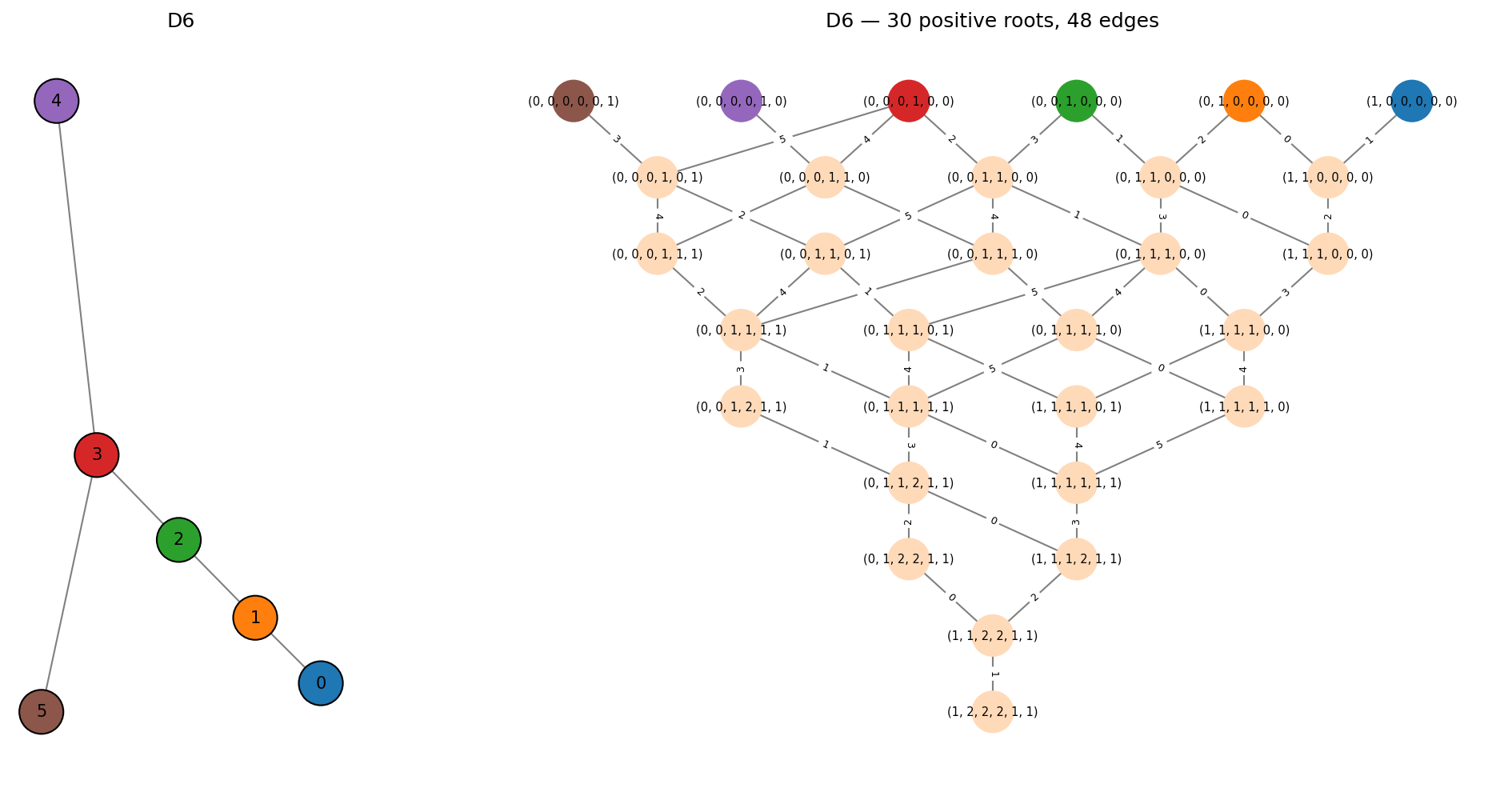
Type D – Forked Graphs
The \(D_n\) Dynkin diagram (\(n \geq 4\)) is a path on \(n{-}1\) nodes with an extra branch at one end:
Node \(n{-}3\) has degree 3, connecting to both \(n{-}2\) and \(n{-}1\). The root system has \(n(n{-}1)\) positive roots and \(2n(n{-}1)\) roots in total. These correspond to the root system of the special orthogonal Lie algebra \(\mathfrak{so}_{2n}\).
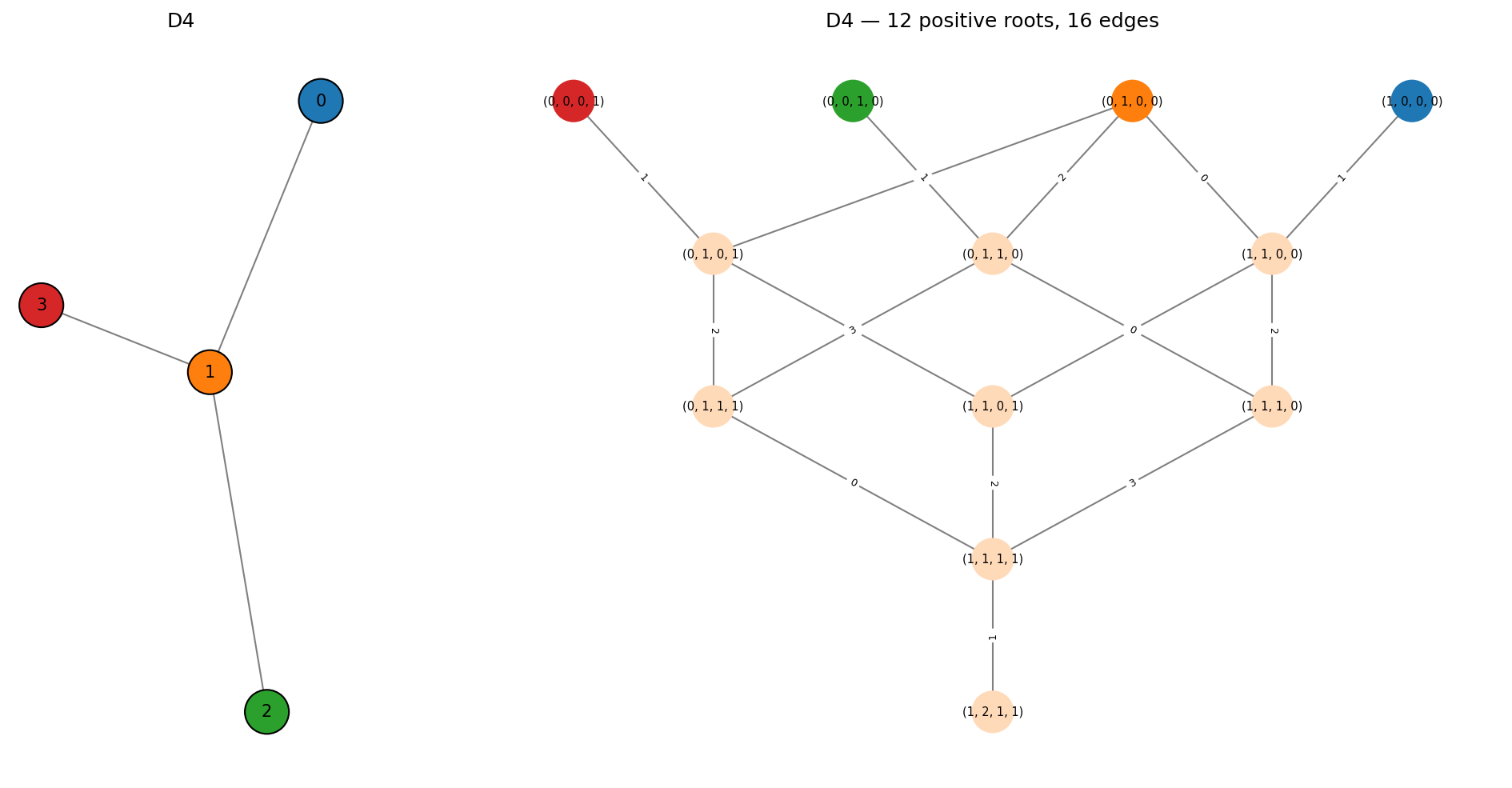
D4
The smallest D-type diagram, with 12 positive roots and 24 total. D4 is notable for having a triality symmetry – the three outer nodes (0, 2, 3) are interchangeable, giving \(D_4\) an unusually large automorphism group (\(S_3\)).
>>> from mutation_game import MutationGame
>>> game = MutationGame.from_dynkin("D4")
>>> print(game.adj)
[[0 1 0 0]
 [1 0 1 1]
 [0 1 0 0]
 [0 1 0 0]]
Node 1 is the central hub connecting to nodes 0, 2, and 3.
The Cartan matrix and its spectrum:
>>> print(game.cartan_matrix())
[[ 2 -1  0  0]
 [-1  2 -1 -1]
 [ 0 -1  2  0]
 [ 0 -1  0  2]]
>>> print(game.cartan_eigenvalues())
[0.58578644 2.         2.         3.41421356]
Note the double eigenvalue at 2, reflecting the triality symmetry.
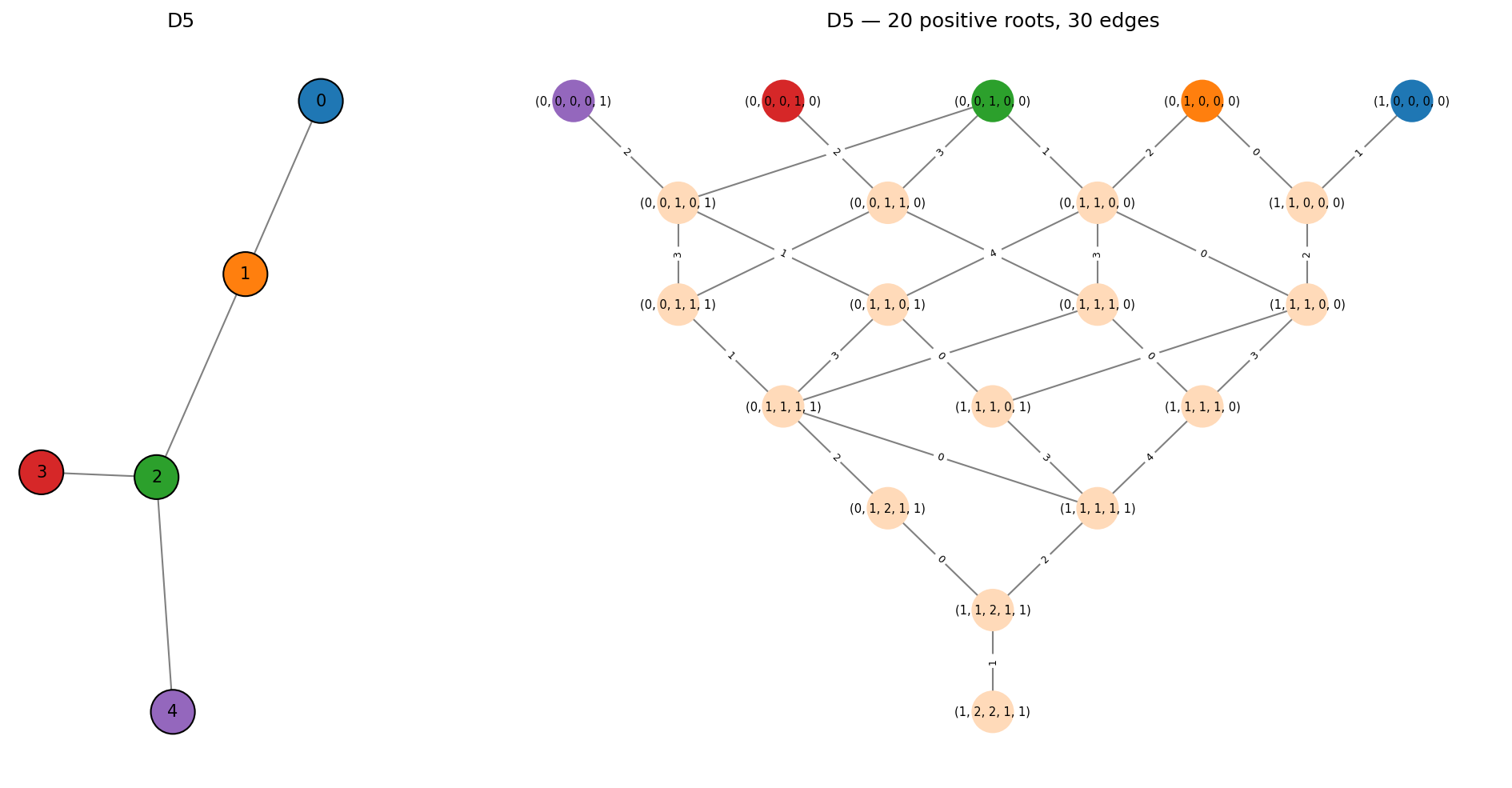
D5
20 positive roots, 40 total. The root system of \(\mathfrak{so}_{10}\).
>>> game = MutationGame.from_dynkin("D5")
>>> print(game.cartan_eigenvalues())
[0.38196601 1.38196601 2.         2.61803399 3.61803399]
D6
30 positive roots, 60 total. The root system of \(\mathfrak{so}_{12}\).