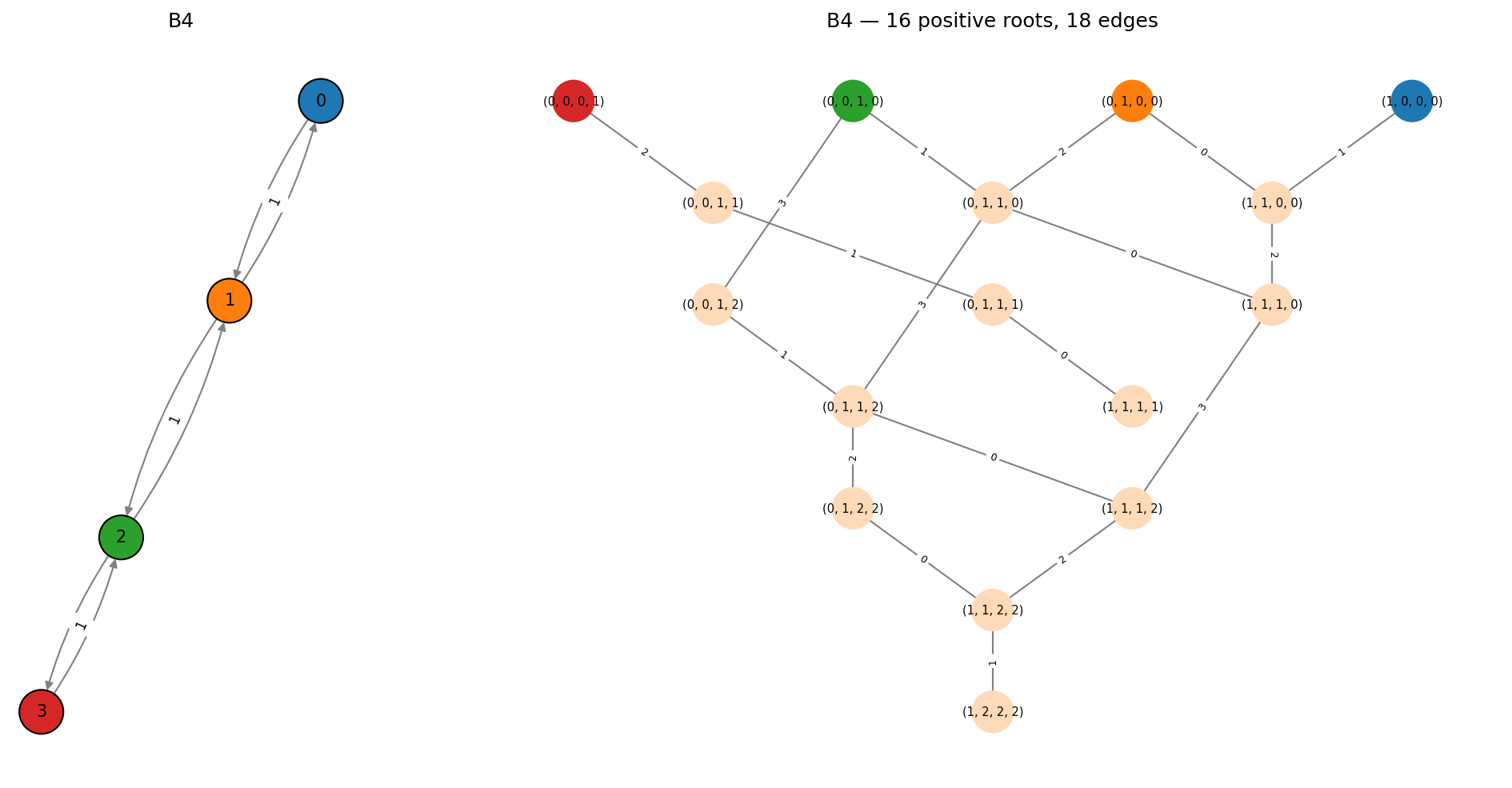
Type B – Odd Orthogonal
The \(B_n\) Dynkin diagram (\(n \geq 2\)) is a directed multigraph: a path on n nodes with a (2,1) directed edge at one end.
That is, there are 2 directed edges from node \(n{-}2\) to \(n{-}1\), and 1 edge back. All other edges are simple (type 1,1).
The root system has \(n^2\) positive roots and \(2n^2\) roots in total. These correspond to the root system of the odd-dimensional orthogonal Lie algebra \(\mathfrak{so}_{2n+1}\).
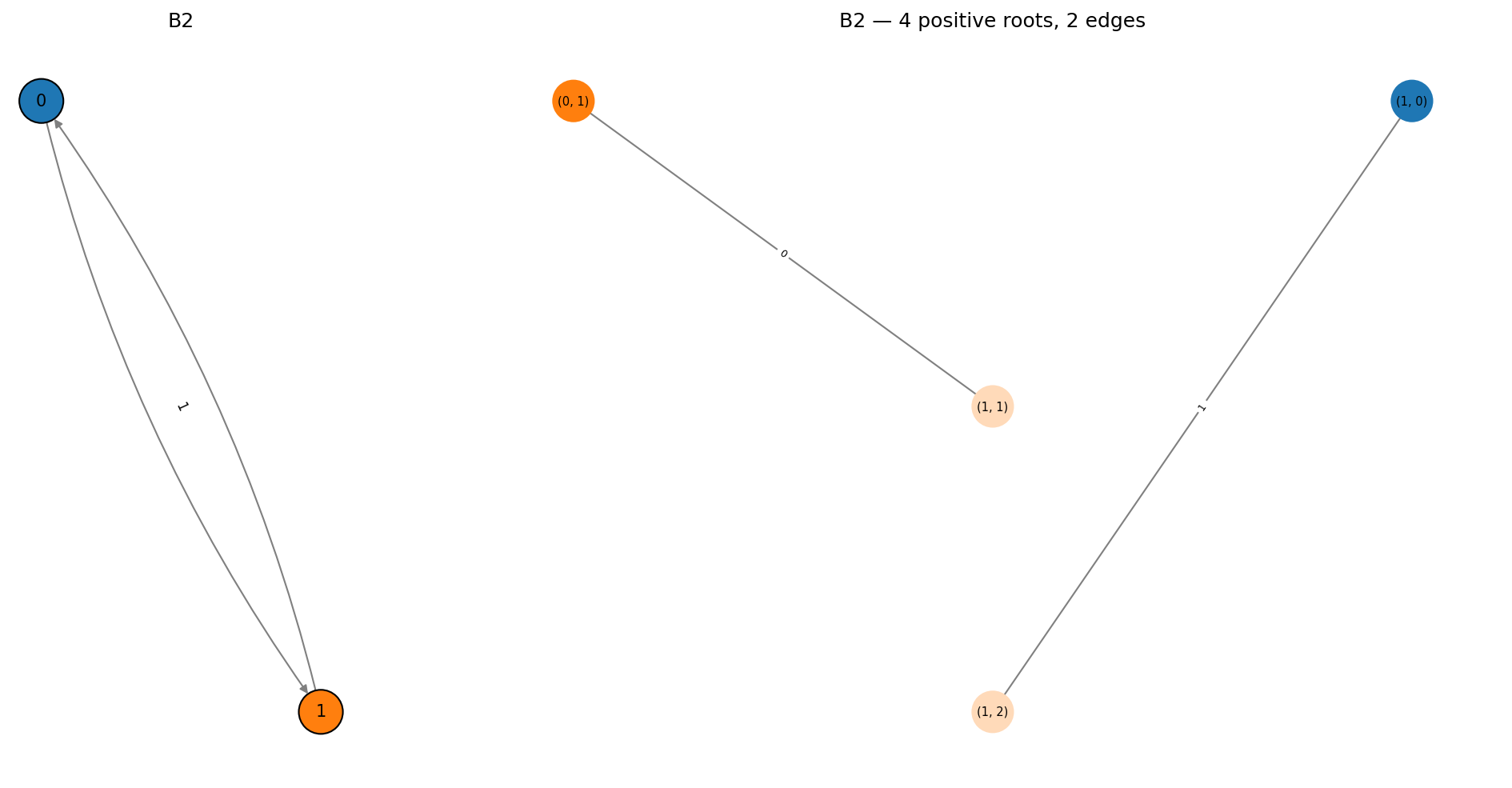
B2
The smallest B-type. 4 positive roots, 8 total.
>>> from mutation_game import MutationGame
>>> game = MutationGame.from_dynkin("B2")
>>> print(game.adj)
[[0 2]
 [1 0]]
The adjacency matrix is not symmetric: 2 edges from node 0 to 1, but only 1 edge back. This is what makes the mutation game different from the simply-laced case – mutating at node 1 receives 2 copies from node 0.
>>> for r in game.calculate_roots():
...     if all(x >= 0 for x in r):
...         print(list(map(int, r)))
[0, 1]
[1, 0]
[1, 1]
[1, 2]
B3
9 positive roots, 18 total. The root system of \(\mathfrak{so}_7\).
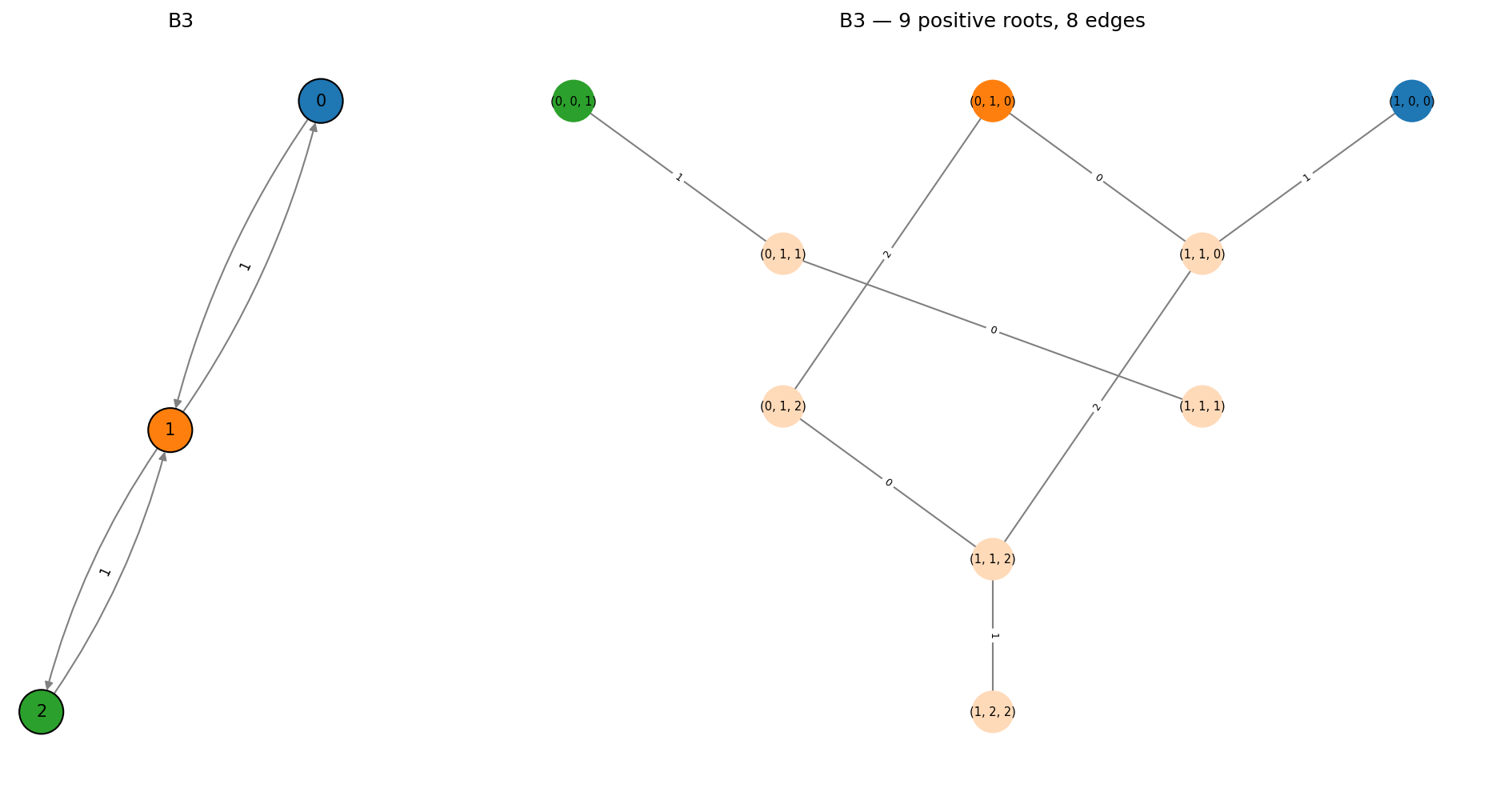
>>> game = MutationGame.from_dynkin("B3")
>>> print(game.adj)
[[0 1 0]
 [1 0 2]
 [0 1 0]]
Note how the double edge appears in the middle of the adjacency matrix:
adj[1,2] = 2 (two edges from 1 to 2) while adj[2,1] = 1.
B4
16 positive roots, 32 total. The root system of \(\mathfrak{so}_9\).