Types F and G – Exceptional Multigraphs
The exceptional non-simply-laced Dynkin diagrams are \(F_4\) and \(G_2\). Together with \(E_6\), \(E_7\), \(E_8\), they complete the list of exceptional finite-type root systems.
Note
Unlike A, B, C, and D, which are infinite families parametrized by rank, \(F_4\) and \(G_2\) are isolated singletons – there is no \(F_5\), \(G_3\), etc. The complete classification of finite-type Dynkin diagrams consists of exactly four infinite families (\(A_n, B_n, C_n, D_n\)) and five exceptional singletons (\(E_6, E_7, E_8, F_4, G_2\)). No others exist.
G2
The simplest non-simply-laced exceptional diagram: 2 nodes with a (3,1) directed edge – three edges from node 0 to node 1, one edge back.
>>> from mutation_game import MutationGame
>>> game = MutationGame.from_dynkin("G2")
>>> print(game.adj)
[[0 3]
 [1 0]]
6 positive roots, 12 total. The Lie algebra \(\mathfrak{g}_2\) has dimension 14 (12 root vectors + 2 Cartan generators). It is the automorphism algebra of the octonions.
>>> for r in game.calculate_roots():
...     if all(x >= 0 for x in r):
...         print(list(map(int, r)))
[0, 1]
[1, 0]
[1, 1]
[1, 2]
[1, 3]
[2, 3]
The highest root is \((2, 3)\) with height 5.
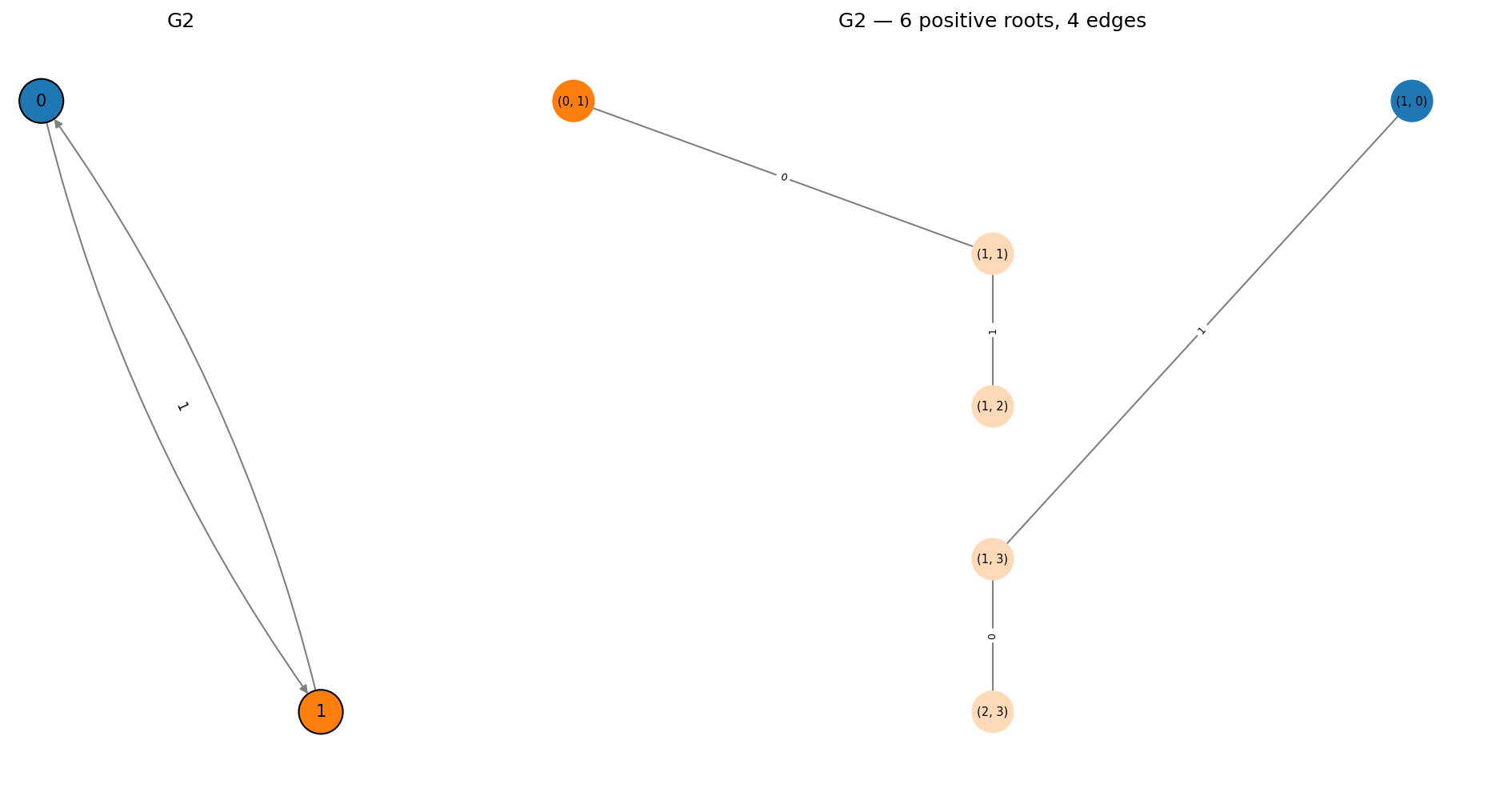
Note the asymmetry: mutating at node 1 receives 3 copies from node 0 (three incoming edges), while mutating at node 0 receives only 1 copy. This produces the long/short root distinction characteristic of G2.
F4
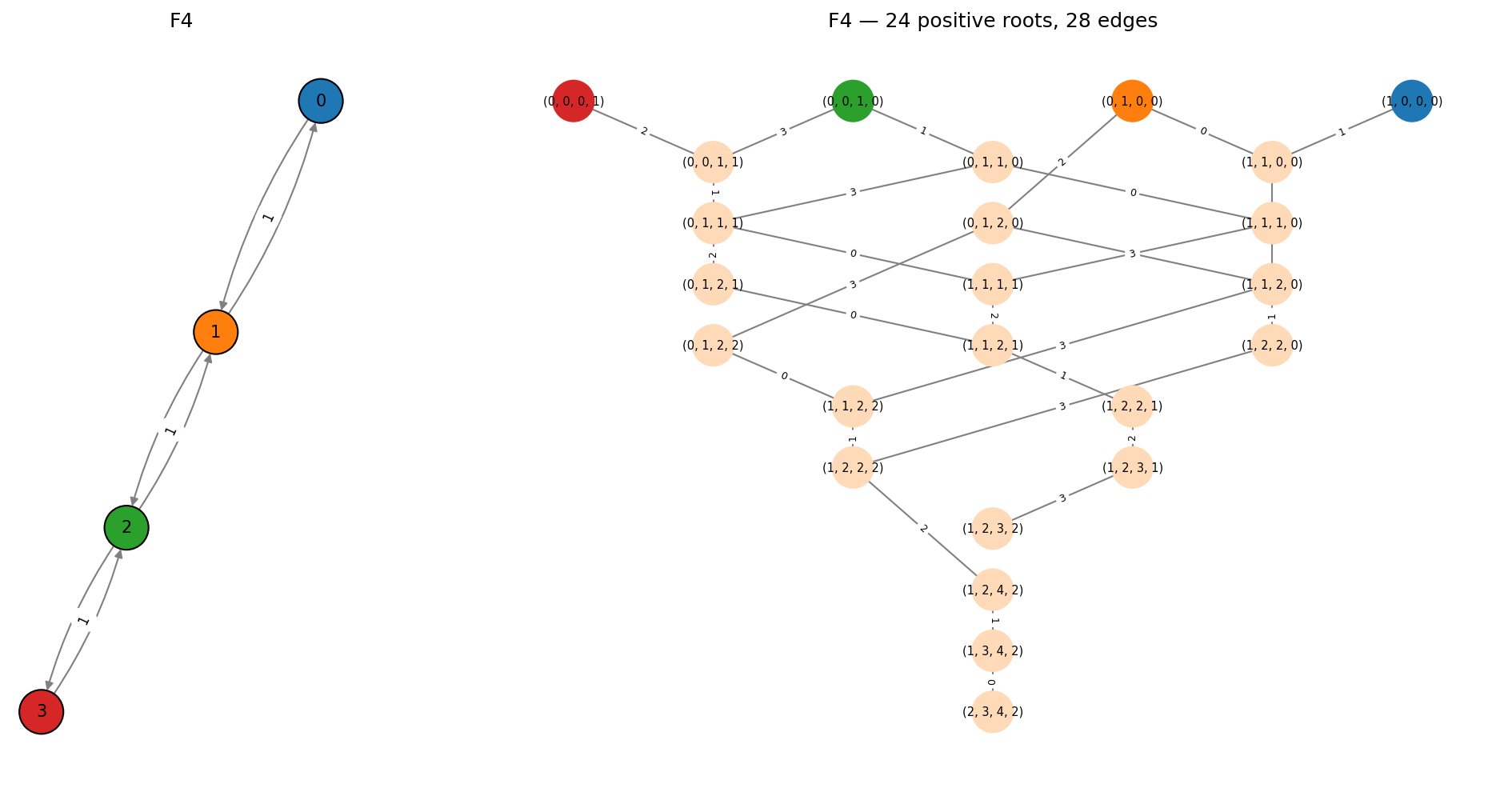
Four nodes with simple edges on the outside and a (2,1) directed edge in the middle:
>>> game = MutationGame.from_dynkin("F4")
>>> print(game.adj)
[[0 1 0 0]
 [1 0 2 0]
 [0 1 0 1]
 [0 0 1 0]]
24 positive roots, 48 total. The Lie algebra \(\mathfrak{f}_4\) has dimension 52 (48 root vectors + 4 Cartan generators).
>>> roots = game.calculate_roots()
>>> pos = [r for r in roots if all(x >= 0 for x in r)]
>>> highest = max(pos, key=lambda r: sum(r))
>>> print(list(map(int, highest)))
[2, 3, 4, 2]
The highest root \((2, 3, 4, 2)\) has height 11.
The generalized Cartan matrix for F4 is non-symmetric:
>>> print(game.cartan_matrix())
[[ 2 -1  0  0]
 [-1  2 -1  0]
 [ 0 -2  2 -1]
 [ 0  0 -1  2]]
The off-diagonal pair C[1,2] = -1 and C[2,1] = -2 reflects the
(2,1) directed edge between nodes 1 and 2.
For a detailed exploration of the F_4 mutation matrices, their pairwise relations, and the Coxeter element, see the Weyl Groups page.
Root count summary
Type |
Graph structure |
Positive roots |
Total roots |
|---|---|---|---|
\(B_n\) (\(n \geq 2\)) |
Path + (2,1) edge |
\(n^2\) |
\(2n^2\) |
\(C_n\) (\(n \geq 3\)) |
Path + (1,2) edge |
\(n^2\) |
\(2n^2\) |
\(F_4\) |
4 nodes, (2,1) middle |
24 |
48 |
\(G_2\) |
2 nodes, (3,1) edge |
6 |
12 |